
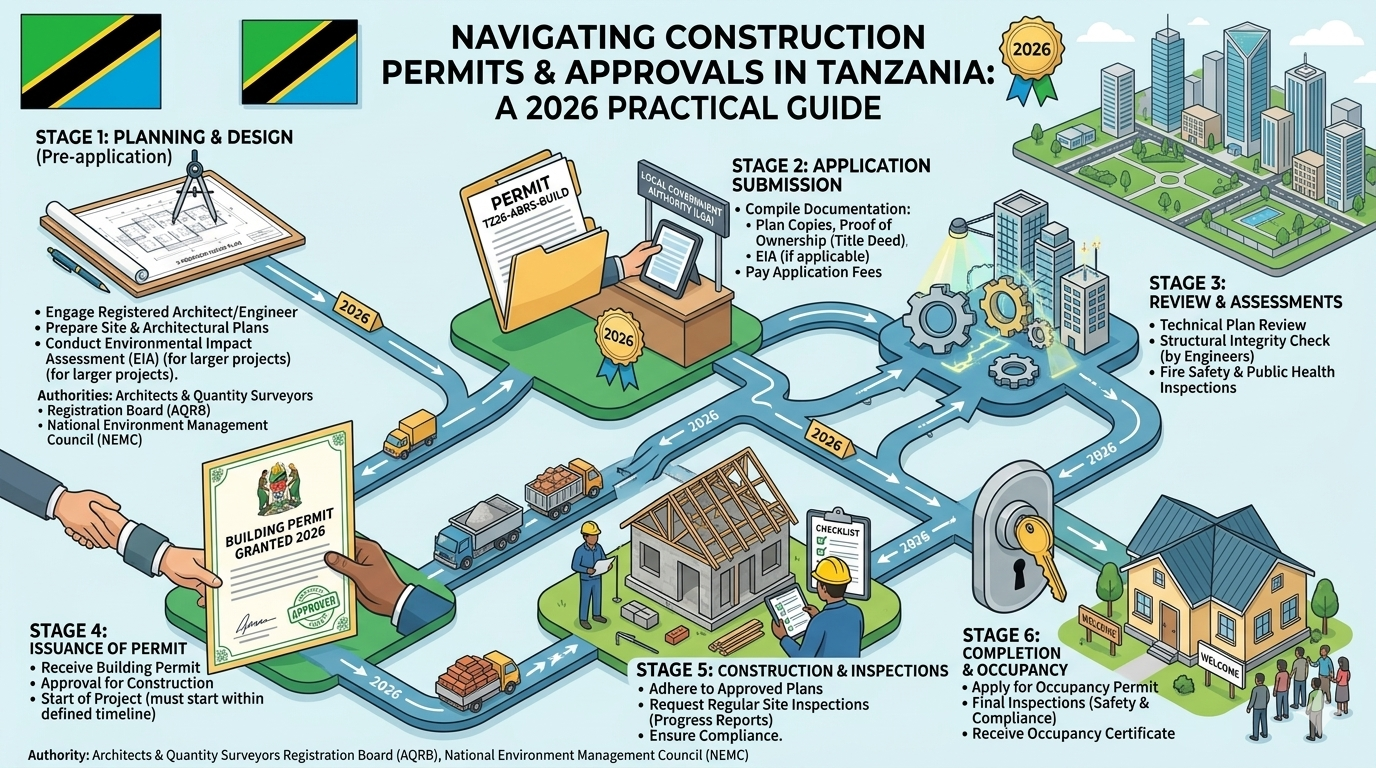
Introduction to Construction Compliance in Tanzania
In the Tanzanian construction landscape, the difference between a successful investment and a legal nightmare often lies in the pre-construction phase. Whether you are developing a commercial complex in Dar es Salaam or a residential villa in Arusha, navigating the regulatory framework is non-negotiable. Local Government Authorities (LGAs) have become increasingly vigilant, and the 'build first, ask for forgiveness later' approach no longer works. This guide outlines the essential steps and authorities involved in securing construction approvals in Tanzania as of 2026.
1. The Foundation: Land Ownership and Title Deeds
Before any architectural drawing is commissioned, land ownership must be verified. In Tanzania, all land is public land vested in the President as trustee. For developers, this means ensuring you hold a valid 'Hati miliki' (Certificate of Occupancy). Under the Ministry of Lands, Housing and Human Settlements Development, the 'Ardhi' digital system has streamlined many processes, but physical verification at the relevant land registry is still recommended.
- Land Use Planning: Ensure your project aligns with the designated use of the land (residential, commercial, or industrial). If the project requires a change of use, this must be applied for and approved by the Director of Town and Country Planning before proceeding.
- Surveying: A registered surveyor must verify the plot boundaries to ensure no encroachment on public space or neighboring private land.
2. Professional Design and Certification
The Tanzanian government requires that all construction designs be prepared by registered professionals. This is not just a safety requirement; it is a prerequisite for permit application. Your team must include:
- Architects: Must be registered with the Architects and Quantity Surveyors Registration Board (AQRB).
- Engineers: Structural, civil, and MEP designs must be stamped by professionals registered with the Engineers Registration Board (ERB).
- Quantity Surveyors: For project costing and bill of quantities (BQ) preparation, also registered with the AQRB.
Using unregistered 'fundis' for the design phase will lead to immediate rejection by municipal authorities. You can discover registered professionals in Tanzania through the BilaFundi platform to ensure your project starts on a compliant footing.
3. The Building Permit (Kibali cha Ujenzi)
The Building Permit is the most critical document. It is issued by the Local Government Authority (Municipal or City Council) where the land is located. To apply, you typically need to submit:
- Certified copies of the Title Deed.
- Current Land Rent receipts.
- Full sets of Architectural and Structural drawings.
- Soil investigation reports (for multi-story buildings).
- The Bill of Quantities (BQ).
- Proof of payment of the application fees (calculated based on the project's total floor area or estimated value).
In 2026, many municipalities are transitioning toward digital submission portals, though some still require physical dossiers. Once submitted, the technical committee reviews the plans for safety, aesthetics, and adherence to urban planning bylaws.
4. Environmental Impact Assessment (EIA)
The National Environment Management Council (NEMC) oversees environmental compliance. Under the Environmental Management Act, certain projects—especially industrial, large-scale residential, or those near sensitive ecosystems—require an Environmental Impact Assessment. Even for smaller projects, a 'Preliminary Environmental Assessment' might be required to determine if a full study is necessary. Failure to secure a NEMC certificate can lead to the immediate halting of works and heavy fines.
5. Workplace Safety and Social Security
Once construction begins, the site is legally considered a workplace. This brings in two more regulatory bodies:
- OSHA (Occupational Safety and Health Authority): The site must be registered with OSHA. They will inspect the site for safety measures, including the provision of Personal Protective Equipment (PPE) for workers and the presence of safety signage.
- WCF (Workers Compensation Fund): Contractors are required to contribute to the WCF to ensure that workers are covered in case of on-site injuries.
6. During and After Construction
Approvals do not end when the permit is issued. The Municipal Engineer's office will conduct periodic inspections at key stages: foundation, slab casting, and roofing. It is the contractor's responsibility to notify the council at these milestones. Upon completion, a final inspection is conducted to issue an Occupation Permit. Without this permit, the building cannot be legally inhabited or connected to permanent utility services like TANESCO (power) or DAWASA (water).
Conclusion
Navigating the Tanzanian regulatory environment requires patience and a commitment to following the law. While the process involves multiple steps—from the Ministry of Lands to NEMC and the local Municipal Council—it protects the value of your investment and ensures the safety of the public. For contractors and developers, staying updated on the latest digital filing requirements is the best way to avoid delays. By working with certified professionals and vetted suppliers, you ensure that your project moves from the drawing board to reality without legal hurdles.